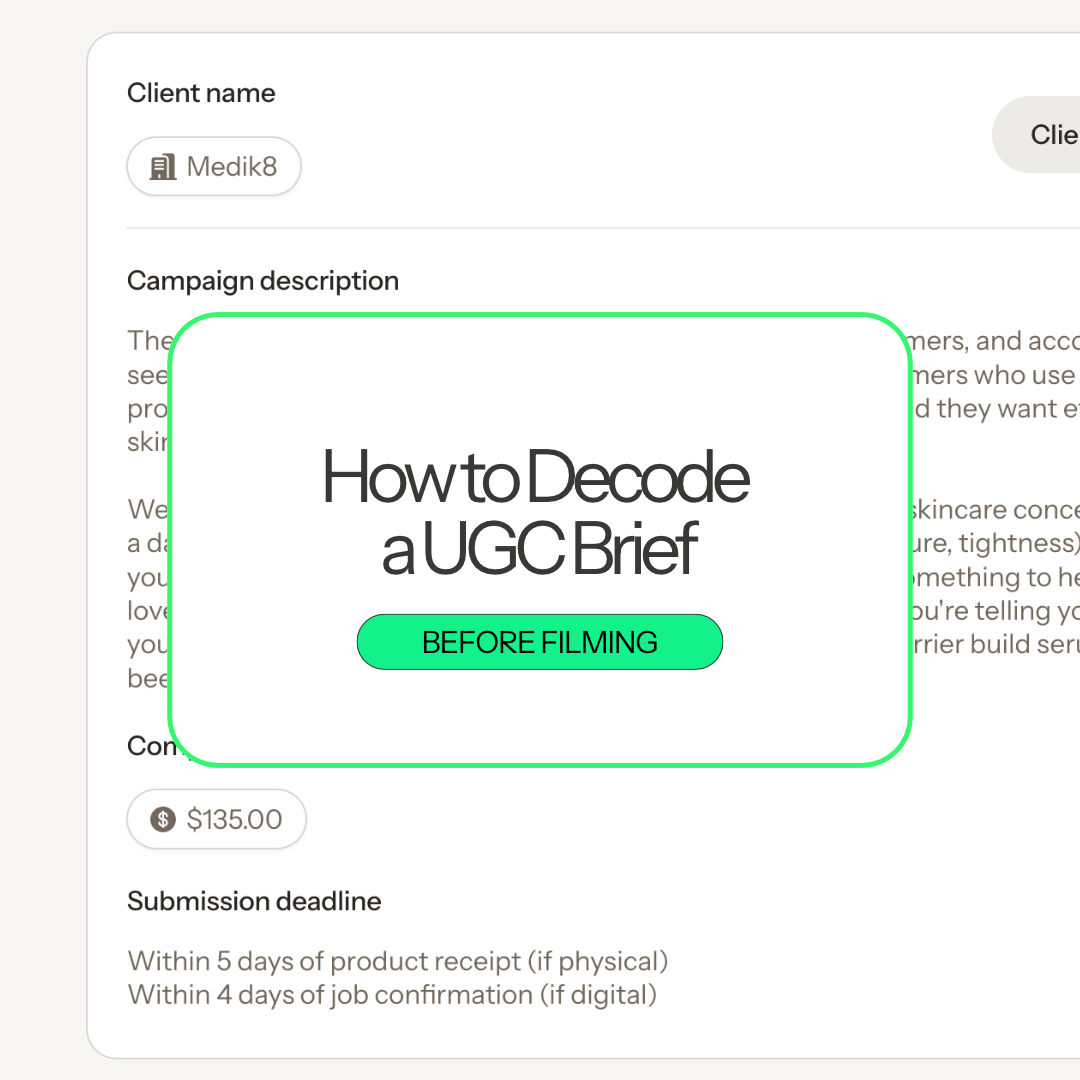
Most creators read a brief once, quickly, and start thinking about the hook. It's understandable, but it's also where a lot of avoidable revisions begin: a key message that got buried, a product detail that got missed, a question that never got asked.
That was the focus of our Twirl creator webinar on turning brand briefs into high-performing content. This blog turns it into seven questions you can use on any UGC brief, with a copy-and-paste decoder at the end.
We'll use one example throughout. Imagine a brief for a razor subscription brand. It mentions free shipping, eco-friendly packaging and an app, includes a few inspiration links, and asks for a 15 to 30 second video with three variations.
1. What is this video for, and where is the viewer in their journey?
Start with the campaign description, then choose the awareness level you're writing for. It shapes your hook, story and call to action:
- Problem aware: they struggle with something but haven't found a fix. Show them this is the answer.
- Solution aware: they know they need something like this. Show them why this brand does it best.
- Product aware: they've been researching. Show them why this one wins.
For the razor brand, a problem-aware viewer is fed up with razor burn. A product-aware viewer is already comparing subscriptions. Those are two very different videos.
Action: write the level at the top of your notes. If the brief only says "drive brand awareness", the choice is yours, so pick the level that fits the product and audience, or ask.
2. What is the brief telling you between the lines?
Read these four signals:
- Inspiration links = format and intent. Watch every one. Meta Ad Library links usually mean the content is meant to run as paid. Organic TikTok or Instagram links usually mean the brand wants it to feel native.
- Tone = the person you're talking to. Words like "assuring" or "urgent" describe the viewer's state of mind, not just your delivery.
- Niche = the world the content lives in. A food brief in Fitness/Sport wants the product shown in that context.
- Why they picked you. Brands often choose a creator because they see their audience in them. Work out what in your portfolio matched, or ask.
Action: note three things the links have in common: how they open, how the product appears and how they end. They aren't scripts to copy, but they show what the brand is picturing.
3. How much room do you have to make it yours?
Scripted doesn't always mean word for word. There's usually room to sound like you, as long as you keep the brand's key beats. Guidance means the direction is set but the words are yours. Reading a script line by line loses the human element, and freestyling without understanding the brief misses the mark.
Action: if it's scripted, mark the lines that must stay exactly as written, such as claims, product names and legal wording, and the ones you can reword. If you can't tell, ask before you film. For more on keeping your voice while staying on brief, see Balancing Creativity and Brand Authenticity in UGC Creation.
4. What is the one message?
Ask: if someone watched this video and was asked about it afterwards, what would they say in one sentence? That's your primary message. For the razor brand: a story about why this razor won't give you razor burn and doesn't break the bank.
Free shipping, eco-friendly packaging and the app are secondary. They can back you up mid-video, but they aren't the headline.
- Too many messages? If you can't summarise the video in one sentence, cut something. If the brief itself asks for too much, push back and offer multiple videos.
- A grocery list of benefits? Say it the way you would out loud. Instead of "It has free shipping, eco-friendly packaging and an app," try "I switched because I was tired of overpaying, and the surprise was how easy it is to manage in the app."
Lead with the message and back it up afterwards. Taking too long to get to the point is a common reason a video loses people. Then see How to Script UGC That Converts: From Hook to CTA to build the script around it.
5. Who exactly are you talking to?
"Adults aged 25 to 40" doesn't give you much to work with. Write this before you film: GET the attention of [target audience] WHO are experiencing [specific need or mindset] TO [desired action or shift] BY showing [your creative approach].
For the razor brand: GET the attention of people who are tired of overpaying for razors WHO keep ending up with razor burn TO try the subscription BY showing a realistic morning routine.
Then give that person a character. If the tone is "assuring" and "urgent", picture someone with a million tabs open who wishes they'd found this sooner. Action: relate it back to you. What in your own life or style makes this audience see you as a peer?
6. What story will you tell, and how will it open?
Pick the storyline that fits both the brief and your style:
- Problem / solution: open on a pain point, land the product as the fix. Clean and high-converting.
- Before / after: show the transformation. Great for beauty, fitness and productivity.
- Day in the life: low-sell, high-authenticity.
- Expectation vs reality: disarms scepticism. Great for objections.
- Educational ("things I wish I knew"): positions you as a peer sharing insight.
- First impression / reaction: raw and real. High trust, especially for new products.
A good hook mentions the keywords, speaks to the audience, and works both visually and verbally. Variations are where creators slip. A new hook means a new verbal and visual opening, not just different words. For the razor brand:
- Problem hook: you say "If your skin hates shaving…" over a close-up in the mirror.
- Price hook: you say "I did the maths on what I was paying for razors…" over receipts or a shelf of products.
- Routine hook: you say "My two-minute morning routine…" over the full set-up laid out.
More ideas in Creating Captivating UGC Hooks.
7. What exactly are you delivering?
This is where small details become big revisions:
- Duration: aim for the top end of the range. It's easier to cut in revisions than to add.
- Variations: count them and plan each hook before you film.
- Product or service: is it sent to you, do you order it and claim it back, or is it digital? If digital, confirm access or ask for screen recordings.
- Formats: know how to crop for different placements before you finish filming.
- Usage: if the inspiration links are paid ads, assume your video may be reused and cropped. Keep faces, products and text well inside the frame, with any disclaimers in the safe zone.
Your brief decoder (copy and paste)
Keep this in your notes app and fill it in before every brief:
- Goal of the video, and awareness level:
- Format and platform (from the inspiration links):
- Scripted or guidance, and must-say lines:
- One message:
- GET / WHO / TO / BY:
- Storyline, and a hook (verbal and visual) for each variation:
- Duration target, and product or access confirmed:
- Questions sent, and concept approved:
The takeaway
The brief gives you the ingredients. You're the chef.
Decode it properly and you can bring your own style to it, like the best UGC creators, without missing what the brand needs. The process is repeatable: read the brief, find the one message, work out who you're speaking to, pick a storyline that suits both the brief and you, then film it in your own voice. And pick briefs that feel close to your world, especially when you're starting out.
If you'd like more frameworks and templates, you'll find them in the Twirl Creator Tools & Resource Hub.